Get the app
← All articles
RANKED · Sep 5, 2026 · 10 MIN READ
How Blocade Ranking Works: Rating, Tiers and the Leaderboard
What your Blocade rating is, how much a ranked win or loss moves it, why a higher rating can sit lower on the board, and who makes the leaderboard.
F
Francis
Creator of Blocade
★ Follow on Google
Every ranked game in Blocade moves a number. Win and it goes up, lose and it goes down, and the leaderboard sorts everyone by it. That part is obvious. What isn't obvious is why your first game swung 150 points and your fiftieth swung 8, why someone with a lower rating can sit above you on the board, or where your name went after a week off. This page explains the whole system, with the real numbers it runs on.
The 20-second version
Your rating starts at 1500 and uses Glicko-2, the same system Lichess uses. It carries a hidden uncertainty that shrinks as you play, so early games swing hard and later games barely move. You get a rating and a tier after 5 placement games. The leaderboard ranks players by rating minus twice the uncertainty, so an unsettled rating sits lower than a settled one. Only players who have played ranked in the last 7 days appear on the board; step away and your spot is held, not lost.
Two numbers, not one
Blocade rates players with Glicko-2, a system designed by Mark Glickman as a successor to Elo. Where Elo tracks one number, Glicko tracks two: your rating, and how sure the system is about it, called the rating deviation. Every account starts at a rating of 1500 with a deviation of 350, which is the system's way of saying it has no idea how good you are yet.
Each game moves both numbers. The rating moves toward whatever the result suggests, and the deviation shrinks because there is now more evidence. How far the rating moves depends on both players' deviations: a result counts for more when your own rating is uncertain, and for less when your opponent's is. That is the whole reason your first few games feel wild and your hundredth feels like a nudge.
It also depends on who was expected to win. Before the game, Glicko turns the two ratings into an expected score. Beat a player rated well above you and you collect far more than a routine win pays. Lose to a player rated well below you and you pay more than a routine loss costs. Beat a much weaker player and you gain very little, because the system already expected it.
Placement: your first 5 games
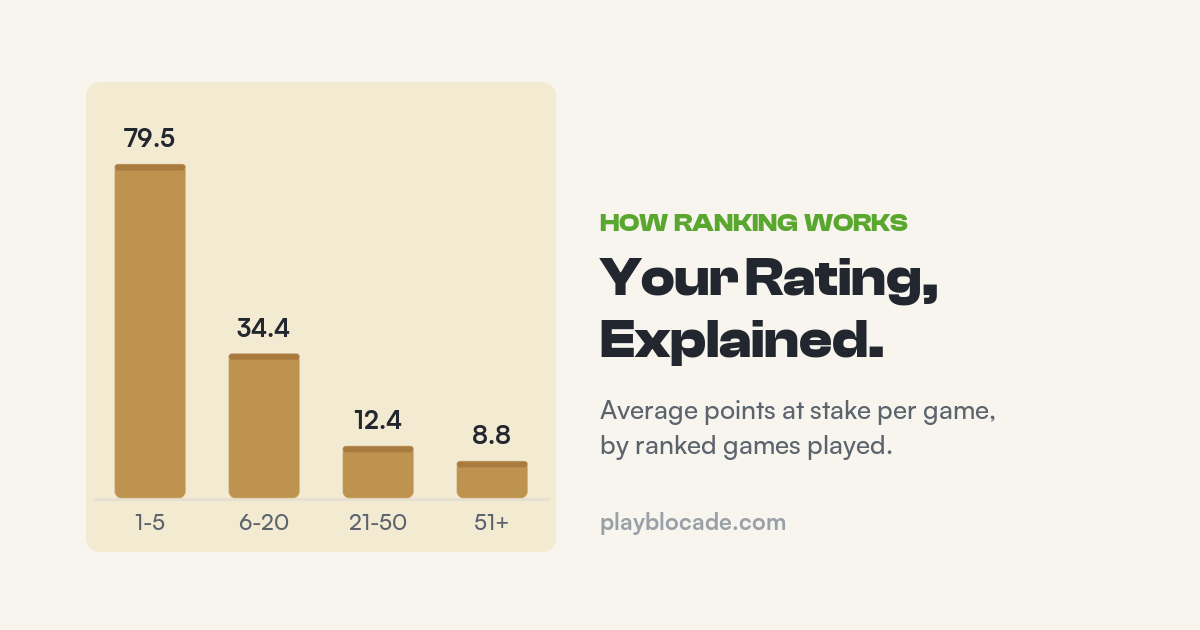
You don't have a rating, a tier or a leaderboard spot until you've finished 5 ranked games. Those games run at full Glicko speed from a 350 deviation, so they move a lot on purpose: the system is trying to find your level in as few games as it can. In the sample further down, games 1 to 5 moved a player 79.5 points on average, and one placement win moved someone 624.
One rule softens the landing. Your first ranked loss ever costs 1 point, whatever the math says. Every loss after that is real.
Why a higher rating can sit lower on the board
This is the question we get asked most. The leaderboard is not sorted by the rating shown on each row. It is sorted by a board score: rating minus twice the deviation. A rating the system is unsure about gets discounted, so a hot streak in someone's first dozen games doesn't put them at the top of the board for a week.
| Player | Rating shown | Deviation | Board score | Rank |
|---|---|---|---|---|
| A, 12 ranked games | 2,050 | 150 | 1,750 | Below B |
| B, 90 ranked games | 1,900 | 60 | 1,780 | Above A |
Player A has the higher rating and the lower rank, and that is the intended result. Until a rating has settled, which takes about 20 ranked games, the row carries a Provisional tag so the ordering reads as deliberate rather than broken. Tiers work differently: your tier comes straight from the rating you see, not from the board score. That is why a Gold badge can appear a few rows below a Silver one.
What one game is worth
Here is what ranked games actually paid in the days after the current rules went live. The sample is every ranked, human-versus-human game completed between 2 and 5 September 2026 that ran at least four moves: 13,804 games, or 27,608 player-games, grouped by how many ranked games that player had finished before it.
Average points at stake per ranked game, by how many ranked games the player had already played. The swings settle as the deviation shrinks.
| Ranked games already played | Player-games | Average points at stake | Average win | Average loss | Largest loss |
|---|---|---|---|---|---|
| 0 to 4 (placement) | 5,582 | 79.5 | +129.5 | −47.0 | −301 |
| 5 to 19 | 9,408 | 34.4 | +35.6 | −33.3 | −186 |
| 20 to 49 | 7,185 | 12.4 | +12.5 | −12.2 | −74 |
| 50 or more | 5,433 | 8.8 | +7.4 | −11.4 | −15 |
Five rules shape the settled end of that table.
•
Once your rating has settled, one game moves it by about 20 points at most. That limit arrives when the Provisional tag comes off, around 20 games. Before that, losses are uncapped, which is why the placement rows above go so deep.
•
A win pays at least 4 points. If the raw math says a heavily favoured win is worth 2, you get 4. The minimum shrinks if you keep beating the same person on the same day.
•
Wins are priced by real results. Between two settled players, what a win is worth comes from how often players that far apart actually beat each other. Ratings make players look further apart than they play, so beating someone a little below you pays more than the raw math alone would, and an upset pays a little less.
•
A rematch counts in full. Playing the same person again straight away pays what the game is worth, just like the first one. Only the minimum shrinks if you keep beating them.
•
The ladder doesn't print points. Whatever a loser is spared by the cap or by the first-loss rule is taken off the winner's gain rather than created from nothing. The winner still gets the 4-point minimum. That is why beating someone on their first ever loss pays 4, not 50.
Put together, a settled player's ranked game moves between 4 and 20 points almost every time. In the sample, players past their fiftieth game gained 7.4 on average and lost 11.4. That gap is not a penalty. Experienced players are usually the favourite, and the favourite is expected to win more often than they lose. Small gains most games and a bigger hit on the occasional upset is what a correct rating looks like from the inside.
Games that pay less, or nothing
•
A game that ends before anyone has really moved pays the winner nothing. A resignation, a walk-away or a clock running out in the opening moves carries no evidence about who is better, so the winner's rating stays where it was.
•
Beating the same opponent over and over in one day stops paying. The 4-point minimum halves with each repeat win, and past a daily limit against one opponent the win does not count at all.
•
Leaving a game is a loss. Resigning, closing the app or letting the clock run out all settle as a normal loss for the player who left.
The tiers
Tiers are a named view of your rating and nothing more. There is no separate tier points system and no promotion match: cross the line and you are in. Drop back below it and the tier drops with you.
| Tier | Rating | Share of placed players |
|---|---|---|
| Bronze | below 1300 | 11.7% |
| Silver | 1300 to 1499 | 23.6% |
| Gold | 1500 to 1699 | 28.1% |
| Platinum | 1700 to 1899 | 22.7% |
| Diamond | 1900 and up | 13.9% |
The median placed player sits at about 1,605, a Gold. The top 10% start at 1,946 and the top 1% at 2,167. Tiers use your rounded rating as the app shows it, so a tier can change on a game that moves you a single point across the line.
Who is on the leaderboard
The board holds the top 100 board scores among players who are placed and have played a ranked game in the last 7 days. If you haven't played this week, you are not on it. Your rating, tier and record don't change while you are away, and one ranked game puts you straight back.
Why hide idle players instead of decaying their rating? Because most players who go quiet for a couple of weeks don't come back, and the ones who do shouldn't pay for a holiday. Hiding the row keeps the board a picture of who is playing now. Decaying the number would tax the returners and do nothing about the leavers.
Ties on board score go to the player with more wins, then fewer losses. The top three rows wear gold, silver and bronze. Anyone in the top ten gets a ring on their avatar that opponents see in-game, unless the rating is still Provisional.
How we measured this
Tier shares come from the profiles of every placed account (5 or more ranked games) on 5 September 2026, with tiers assigned from the rounded rating. The points-at-stake table uses every ranked, human-versus-human game completed between 2 September 2026 at 10:05 UTC and 5 September, keeping only games that reached at least four moves. Each game contributes two rows, one per player, and a player's game count is their position in their own ranked history. The caps, minimums and the board rule are read from the live settlement and leaderboard functions, not from documentation.
Last checked 14 September 2026
The caps and minimums get tuned from time to time. The rules on this page were checked against the live system on the date above; the tables are samples from the dates in their captions. If the app and this page ever disagree, the app is right.
Blocade rating and leaderboard: frequently asked questions
What rating system does Blocade use?
Glicko-2. Every account starts at a rating of 1500 with a rating deviation of 350. Both numbers update after every ranked game. Unranked games, friend games and Blocade Royale never touch them.
How many games until I get a rating?
5 ranked games. After the fifth one you get a rating, a tier and a spot on the leaderboard. The rating stays tagged Provisional, and is ranked cautiously, until about game 20.
Why did I lose more points than I won?
Because you were the favourite. A win you were expected to get pays little (never less than 4), and a loss to someone rated below you pays the full amount (about 20 at most once your rating has settled). Win a bit more often than the system expects and you climb; that is the whole game.
Why is someone with a lower rating ranked above me?
The board sorts by rating minus twice the deviation, not by the rating itself. If your rating is newer or less certain than theirs, it is discounted more. Play more ranked games and the discount shrinks.
Why did I disappear from the leaderboard?
The board only shows players who have played a ranked game in the last 7 days. Your rating, tier and record are untouched. Play one ranked game and you are back where your score puts you.
I won and only got 4 points. Why?
Four is the minimum for a win. You get exactly that when the raw math paid less: a win you were heavily expected to take, or a win against someone the cap or the first-loss rule protected. Repeatedly beating the same person on one day pays less than 4.
Do I lose points if my opponent leaves?
No. Leaving is a loss for the player who left and a win for you. If they leave before the game has really started, it doesn't pay you either, but it costs you nothing.
Is ranked free?
Yes. Free accounts get a daily allowance of ranked games; Blocade Plus removes the limit. The rating math is identical either way.
Does Blocade Royale change my rating?
Only upward. Each Royale game you win on the board adds +5 to your rating; going out costs nothing. A no-show win also adds +5 if you were in the app for the match; byes add nothing. There is more on the nightly cup in the Blocade Royale guide.
Get placed
Ranked lives in the app. In the browser you can play the bots and the daily puzzle, which is the right place to learn the game; the ladder, the tiers and the board are on iOS and Android. 5 games and you have a number of your own.
Play Blocade free
F
Francis
CREATOR OF BLOCADE
Francis is the solo developer who designed and built Blocade — its bots, ranked ladder, and daily puzzles. These guides come straight from the person who made the game.
Follow Blocade on Google Search
Add playblocade.com to your Google Preferred Sources so Google shows the official game, guides, and daily puzzle solutions in AI Overviews and Search.
Add as Preferred Source
Ready to play?
Start a game against a bot right in your browser — free, no sign-up. Then take your streak with you on the app.