Get the app
← All articles
RULES · Jul 9, 2026 · 6 MIN READ
How to Play Blocade: Rules, Setup & Beginner Strategy
Learn how to play Blocade in 5 minutes: the goal, moving your pawn, placing walls, the no-full-block rule, and simple strategy to start winning.
F
Francis
Creator of Blocade
★ Follow on Google
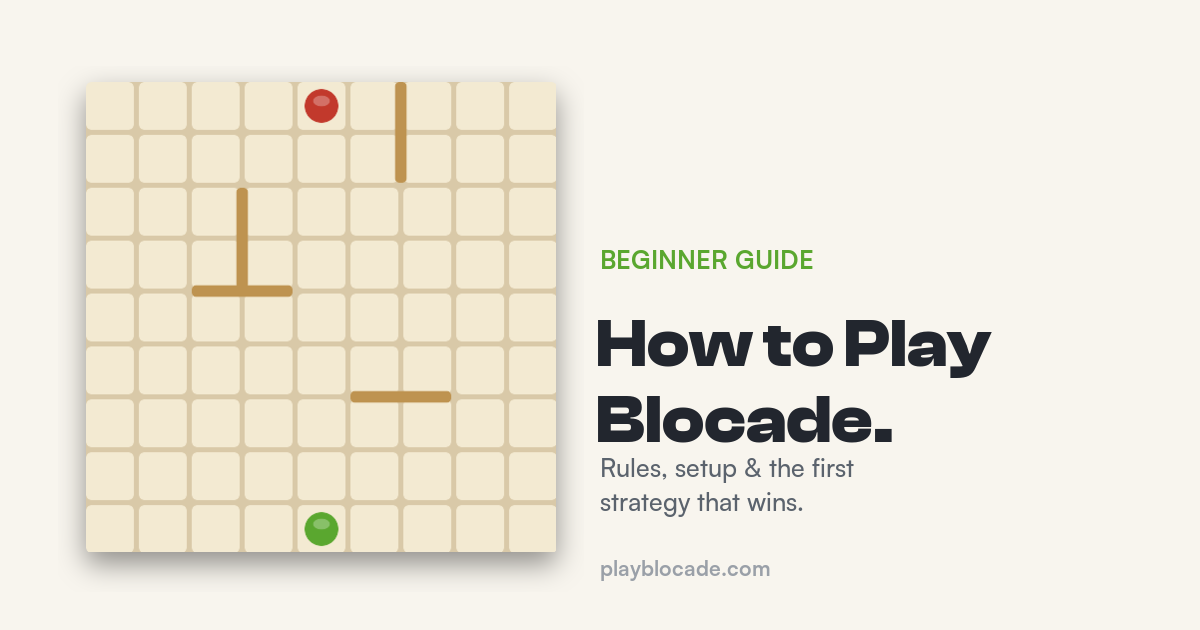
Blocade is a fast two-player strategy board game with a deceptively simple idea: be the first to walk your pawn to the other side of the board — while dropping walls to send your rival the long way around. It takes about a minute to learn and a good while to master, which is exactly why one more game turns into ten.
The 20-second version
On your turn you do one of two things: move your pawn one square, or place a wall. Race to the far row before your opponent reaches theirs. You can slow them with walls — but you can never wall someone off completely.
The goal
You and your rival start on opposite sides of a 9×9 grid, each pawn centered on your home row. You win the moment your pawn reaches any square on the opposite side. Green is trying to get to the top; red is trying to get to the bottom. First one there wins — so every turn is a quiet race.
Setting up
•
A 9×9 board. Your pawn starts on the middle square of your home row, your opponent on the middle of theirs.
•
A shared shortest path runs straight up the middle — but almost nobody gets to walk it uncontested.
•
You each get a pool of walls (10 each in the classic game). Walls are the whole reason this is a strategy game and not a footrace.
Your turn: move or place a wall
Every turn is a single choice — move, or wall. Not both. That one constraint is where all the tension lives: every wall you place is a step you didn't take, and every step you take is a wall your rival gets to place first.
Moving your pawn
A pawn moves one square per turn — up, down, left, or right. No diagonals, no sprinting. If you just want to get to the far side as fast as possible, you march one square at a time along the shortest open path.
Placing a wall
Instead of moving, you can drop a wall between squares. A wall is two segments long and blocks movement across that edge — for both players — until the game ends. Walls can't overlap and can't cross another wall. Place them to lengthen your opponent's route to their goal: a well-timed wall can turn a two-move finish into a fifteen-move detour.
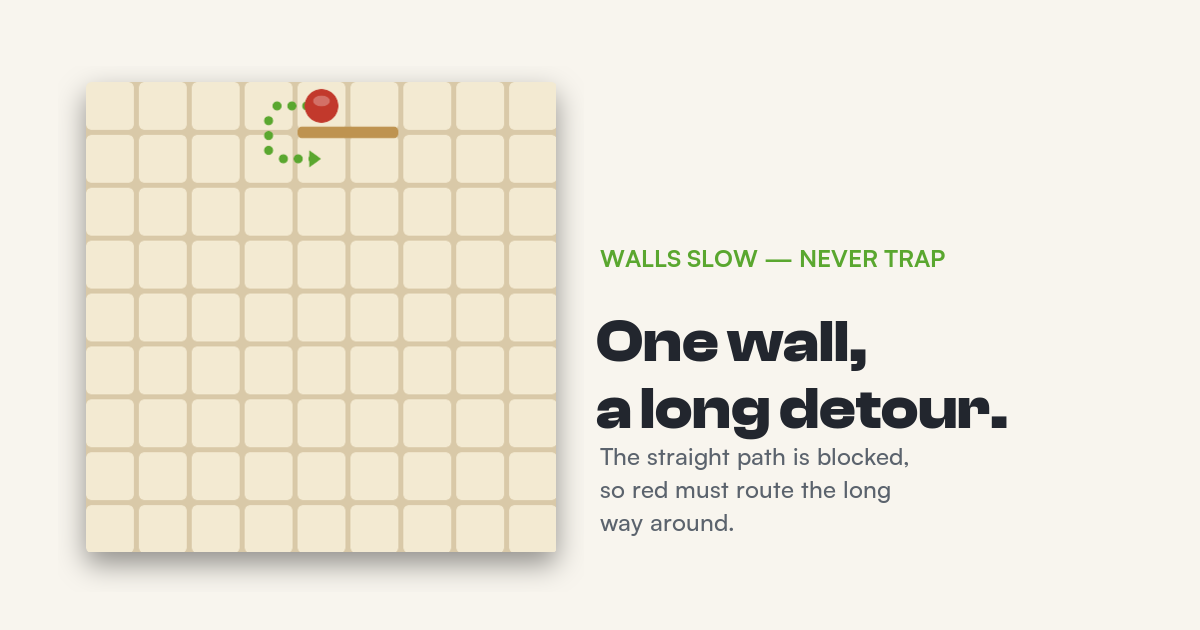
One wall, placed at the right moment, can add a dozen squares to your rival’s route.
The one rule that keeps it fair
You can never fully block a player
At all times, each pawn must have at least one legal path to its goal. You can bend and lengthen a route as much as you like — but a wall that would seal an opponent in completely is illegal and can't be placed. So walls are for slowing, funneling, and misdirecting, never for trapping.
This single rule is what turns Blocade from a blocking contest into a genuine strategy game. Because you can't just wall someone into a box, you're forced to think about tempo — who's spending turns racing and who's spending turns building — and about geometry: which detour is actually longer once you account for the walls your opponent still holds.
Jumping an adjacent pawn
When the two pawns end up face to face on neighboring squares, you're allowed to hop straight over your opponent to the square beyond. If a wall (or the board's edge) sits directly behind them, you can instead jump diagonally to either open side. It's a small rule, but it matters in the endgame, when both pawns are squeezing through the same narrow corridor.
Simple strategy to start winning
You don't need theory to get good, fast. A handful of habits will beat most beginners:
1.
Move first, wall later. Early walls are cheap for your opponent to route around. Bank your walls until they actually cost your rival real distance.
2.
Count the path, not the wall. Before you place a wall, picture your opponent’s new shortest route. If it only adds a square or two, you just wasted a turn — and a wall.
3.
Race when you’re ahead. If your shortest path is shorter than theirs, stop building and run. Walls can’t trap them, so a lead in the race is a lead you can just spend.
4.
Save walls for the finish. A wall dropped when your rival is two squares from home is worth ten dropped at the start.
5.
Watch your own escape routes. Every wall blocks both of you. Don’t build a maze you have to walk through too.
From the official @blocadeapp on TikTok ↗
Blocade, Quoridor, and that other "-cade"
If the mechanic feels familiar, it should: Blocade belongs to the same lineage as Quoridor, the classic race-and-wall abstract strategy game. Blocade is our own fast, modern take on it — built for your phone, with bots to practice against, daily puzzles, and online ranked matches. If you searched for “barricade” or “blockade” and landed here, you’re in the right place — the game is Blocade (no “r”), and you can play it free in your browser or on your phone.
Blocade rules: frequently asked questions
How long does a game of Blocade take?
A typical game runs about 2–5 minutes — fast enough for "just one more," which is exactly the point.
How many walls do you get?
In the classic game each player has 10 walls. You choose when to spend them: hold too long and your rival runs; spend too early and they just route around.
Can you win by completely trapping your opponent?
No. A wall that would leave your opponent with no path at all to their goal is illegal. Walls can only lengthen a route, never seal it — which is what keeps Blocade a strategy game instead of a blocking contest.
Is Blocade the same as Quoridor?
They share the same race-and-wall mechanic (a public-domain idea). Blocade is a modern, mobile-first take on it with bots, daily puzzles, and online ranked play. See our Blocade vs Quoridor vs Barricade guide.
Is Blocade free, and do I need to download it?
Blocade is free to play. You can start instantly in your browser with no download or sign-up, and the full app is free on iOS and Android.
Play your first game
The fastest way to learn is to play a round against a gentle bot — it walks you through the rhythm of move-or-wall without any pressure. You can start right now in your browser, no download or sign-up needed, then take your streak with you on the app.
Once the rules feel automatic, there's a free knockout tournament every night: 128 players, 7 rounds, one crown, done inside the hour. Our Blocade Royale guide explains how the bracket works and how to get a seat.
Play Blocade free
F
Francis
CREATOR OF BLOCADE
Francis is the solo developer who designed and built Blocade — its bots, ranked ladder, and daily puzzles. These guides come straight from the person who made the game.
Follow Blocade on Google Search
Add playblocade.com to your Google Preferred Sources so Google shows the official game, guides, and daily puzzle solutions in AI Overviews and Search.
Add as Preferred Source
Ready to play?
Start a game against a bot right in your browser — free, no sign-up. Then take your streak with you on the app.