Get the app
← All articles
RULES · Jul 9, 2026 · 8 MIN READ
Quoridor Rules Explained: How to Play in 5 Minutes
Learn Quoridor in 5 minutes: the 9×9 board, 10 walls each, move-or-wall turns, jumping, and the no-full-block rule — then play the same rules free online.
F
Francis
Creator of Blocade
★ Follow on Google
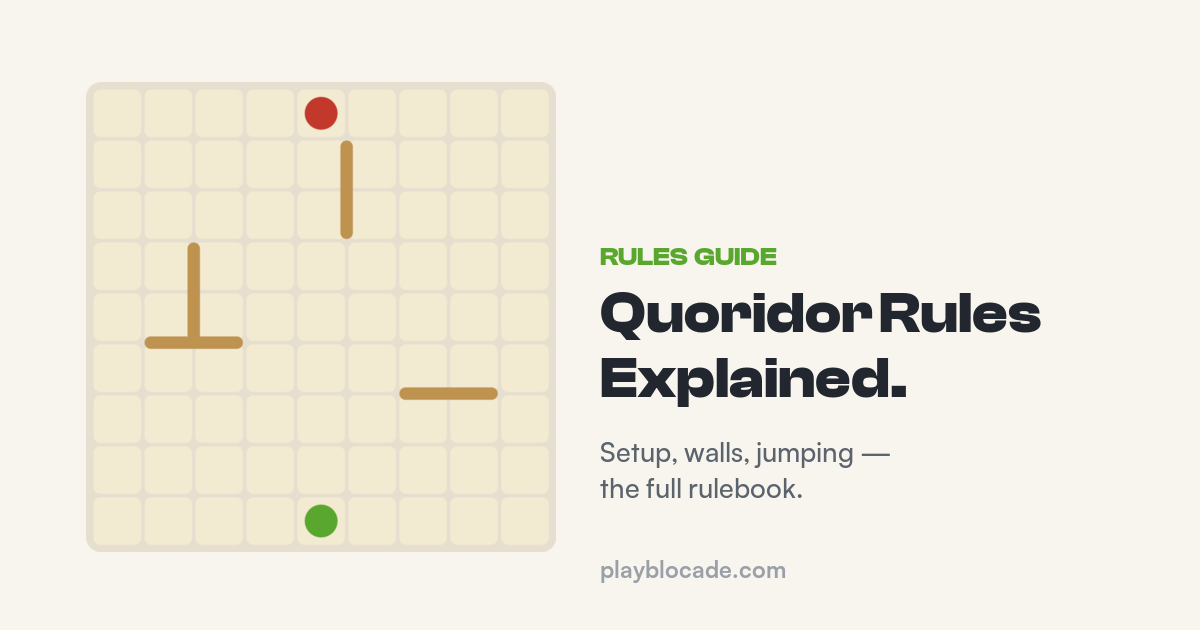
Quoridor is played on a 9×9 board by two players (or four, in the corners variant). Each turn you do one of two things — move your pawn one square, or place a wall — and the first pawn to reach the opposite side wins. Walls slow your opponent down, but a strict rule stops anyone from ever being fully trapped. That's the whole game; the rest is strategy.
The 20-second version
9×9 board, pawns start facing each other. Each player gets 10 walls (5 in four-player games). On your turn: move one square, or place one wall. First pawn to the far row wins. You can never place a wall that would leave an opponent with zero path to their goal.
How to play Quoridor, step by step
1.
Set up the board. Place the 9×9 board between you. Each pawn starts on the middle square of its own home row, facing the other pawn across the board.
2.
Share out the walls. Each player takes 10 walls (5 each with four players) and keeps them off the board until used.
3.
Take turns. Pick one action per turn: move your pawn one square (up, down, left or right), or place one wall in a slot between squares.
4.
Place walls to slow your rival. A wall covers two squares and blocks both players from crossing it for the rest of the game. It must leave every pawn at least one route to its goal.
5.
Jump when face to face. If the pawns land on neighbouring squares, the player to move may hop straight over the other pawn, or diagonally if a wall sits behind it.
6.
Reach the far row to win. The first pawn to step onto any square of the opposite edge wins immediately. Walls left over don’t count for anything.
That is a complete game. The sections below go through each of those steps in detail, with the edge cases a rulebook glosses over.
The board and setup
•
A 9×9 grid of squares, sitting on a frame with slots for walls between the squares.
•
Two players face off from opposite sides; each pawn starts on the middle square of its home row.
•
In a four-player game, all four sides are used and each player gets fewer walls (5 instead of 10).
•
Between the two players, there’s a shared shortest path straight up the middle — walls are what turn that into a real race.
How many walls does each player get?
In the standard two-player game, each player has 10 walls to place over the course of the match — 20 total. In the four-player variant, that drops to 5 walls each. Walls are a limited resource: once you've placed all of yours, you can only move for the rest of the game, so when to spend them is one of the game's central decisions.
Playing with four? The setup, turn order, and the no-block check all change alongside the wall count — the four-player Quoridor rules cover the full variant, including the 2v2 team game.
Your turn: move or place a wall
Every turn is exactly one action — move your pawn, or place a wall. Never both, never neither. That single constraint is where all of Quoridor's strategy comes from: every wall you place is a turn you didn't spend moving, and every move you make is a turn your opponent gets to build.
Moving your pawn
A pawn moves one square at a time — up, down, left, or right, never diagonally (outside of a jump, below). If nothing is in your way, reaching the far row is just a matter of counting squares.
Placing a wall
A wall spans two square-widths and drops into the slots on the board frame, blocking movement across that edge for both players, for the rest of the game. Walls can't overlap another wall and can't cross one at a right angle in a way that would seal a square shut illegally. Placed well, a single wall can turn a two-move finish into a fifteen-move detour.
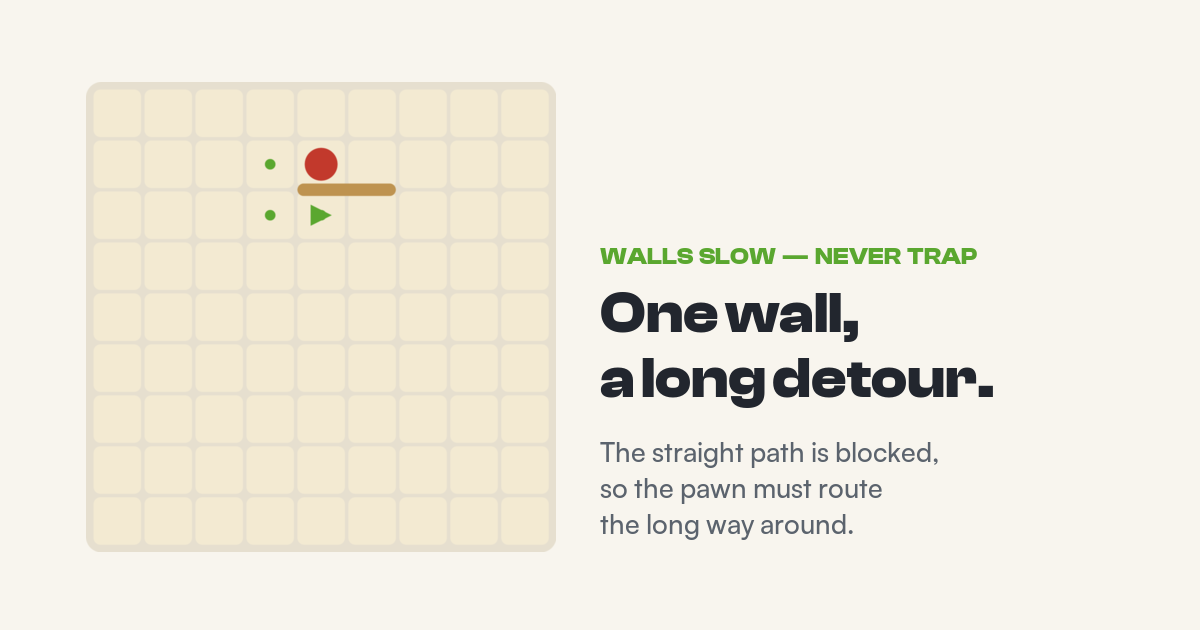
One wall, placed at the right moment, can add a dozen squares to your rival’s route.
The no-full-block rule
You can never fully trap a player
This is the rule that makes Quoridor a strategy game instead of a blocking puzzle: at all times, every pawn must have at least one legal path to its goal. A wall that would seal a player in completely is illegal and simply can't be placed, even if it's your last wall and it would otherwise win the game outright.
Because you can never wall someone into a box, the game rewards tempo and geometry instead: who's spending turns racing versus building, and how much longer an opponent's route actually gets once you account for the walls they still have left to clear their own way.
Can you jump over a pawn?
Yes. If the two pawns end up on adjacent squares facing each other, the player to move can jump straight over the opponent's pawn, landing on the square beyond. If a wall (or the edge of the board) sits directly behind the opponent so a straight jump isn't possible, you instead jump diagonally to either open square beside them. It's a small rule, but it matters a lot in the endgame, when both pawns are squeezing through the same narrow corridor.
Quoridor rules at a glance
| Rule | 2 players | 4 players |
|---|---|---|
| Board size | 9×9 | 9×9 |
| Walls per player | 10 | 5 |
| Turn action | Move 1 square OR place 1 wall | Move 1 square OR place 1 wall |
| Win condition | Reach the opposite row | Reach the opposite row |
| Full-block walls | Illegal — always ≥1 path required | Illegal — always ≥1 path required |
| Jumping | Straight, or diagonal if blocked | Straight, or diagonal if blocked |
Basic Quoridor strategy
1.
Don’t wall early. A wall placed in the opening is cheap to route around. Hold your walls until they actually cost your opponent real distance.
2.
Count squares, not walls. Before placing a wall, trace your opponent’s new shortest path. If it only adds a square or two, you just spent a wall for nothing.
3.
Race when you’re ahead. Walls can’t trap anyone, so if your path is shorter than theirs, stop building and run — a lead in the race is a lead you can simply spend.
4.
Save your last walls for the finish. A wall dropped when your opponent is two squares from home is worth far more than one dropped on move three.
5.
Watch your own path too. Every wall blocks both players — don’t build a maze you end up walking through yourself.
Those five habits beat most casual players. For the deeper layer — openings, wall fences, jump tempo, and the endgame count — see our full Quoridor strategy guide.
From the official @blocadeapp on TikTok ↗
What does “Quoridor” mean?
The name is a play on the word corridor — the game is about opening a corridor for your own pawn while walling off your opponent's. That's why so many people search for it as the "corridor game" or "corridor board game", and why the rules on this page apply to it under either name. It's pronounced much like corridor too.
Where does Quoridor come from?
Quoridor is an abstract-strategy board game first published in 1997 by the French company Gigamic. It’s the game that made the "move-or-wall" mechanic famous — and because that core idea isn’t owned by any one product, it’s since been reimagined across plenty of digital games, including Blocade, a free, mobile-first take built for your phone and the web. See our Blocade vs Quoridor vs Barricade comparison for how the versions differ.
Quoridor rules: frequently asked questions
How many walls do you get in Quoridor?
In the standard two-player game, each player gets 10 walls (20 total). In the four-player variant, each player gets 5 walls.
Can you jump over a pawn in Quoridor?
Yes — if the two pawns are adjacent and facing each other, you can jump straight over to the square beyond. If a wall or the board edge blocks that straight jump, you jump diagonally to either open side instead.
Can you completely block your opponent in Quoridor?
No. A wall that would leave an opponent with zero legal path to their goal is illegal and cannot be placed, no matter whose wall it would be or how close it is to winning.
What does the name Quoridor mean?
It’s a play on the word corridor. The whole game is about keeping a corridor open for your pawn while walling up your opponent’s, which is why it’s often called the "corridor game".
How big is a Quoridor board?
The board is a 9×9 grid of squares in both the two-player and four-player variants — only the number of walls per player and starting positions change.
How long does a game of Quoridor take?
A typical two-player game runs about 10–20 minutes on a physical board. Digital versions like Blocade play much faster — most matches finish in 2–5 minutes.
Is there a free way to play Quoridor online?
Blocade is a free, modern take on the same race-and-wall rules, playable instantly in your browser or on iOS/Android — see our how to play Blocade guide to get started.
Try the rules yourself
The fastest way to actually learn these rules is to play them. Blocade uses the same move-or-wall, no-full-block, jump-when-adjacent ruleset — free, in your browser, no download or sign-up required.
Play free — no download
F
Francis
CREATOR OF BLOCADE
Francis is the solo developer who designed and built Blocade — its bots, ranked ladder, and daily puzzles. These guides come straight from the person who made the game.
Follow Blocade on Google Search
Add playblocade.com to your Google Preferred Sources so Google shows the official game, guides, and daily puzzle solutions in AI Overviews and Search.
Add as Preferred Source
Ready to play?
Start a game against a bot right in your browser — free, no sign-up. Then take your streak with you on the app.