Get the app
← All articles
ENGINEERING · Sep 21, 2026 · 10 MIN READ
Searching Deeper Fixed Nothing: Notes From Building a Quoridor Engine
We re-searched 182 of our Quoridor engine’s mistakes two plies deeper. It fixed zero of them. What that taught us about evaluation, randomness, and a bot that walled itself in.
F
Francis
Creator of Blocade
★ Follow on Google
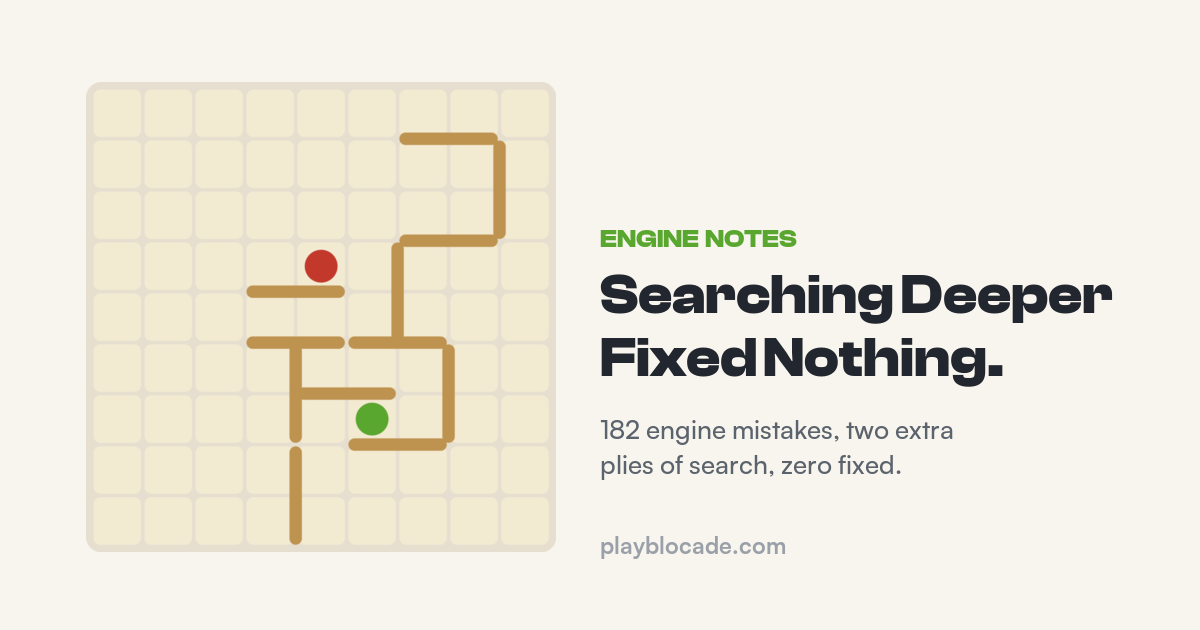
Our Quoridor engine had a list of 182 positions where it saw a threat, searched past it, and still played the losing move. The obvious fix was to search deeper. So before writing any code, we re-ran all 182 positions at one and then two extra plies. Depth 6 fixed two of them. Depth 7 fixed none, and took six times as long to get the same wrong answer.
That one afternoon of measurement killed a project we had already scheduled, and it changed how we think about the engine. This post is the record: how we grade a Quoridor bot without letting it grade itself, what the depth experiment showed, what randomness costs, and a game where our strongest bot built its own cage. Blocade is a Quoridor-style game, so all of this comes from an engine that ships in the app's practice mode. If you don't know the game, the rules take five minutes.
The engine in one paragraph
Quoridor is a race on a 9×9 board. Each turn you move your pawn one square or place one of your ten walls, and the first pawn to the far side wins. The engine is a plain alpha-beta search with a transposition table. Its evaluation is the number most Quoridor programs use: the length of my shortest path to goal, minus the length of yours, computed by breadth-first search over the walls on the board. On top of that sits some tuning for wall counts and move parity. The shipped practice bots run this search between depth 1 and depth 5, with node budgets up to 200,000, and the strongest of them plays somewhere around 1700 to 1800 against rated humans.
The branching factor is the problem. A pawn has at most five moves, but there are up to 128 legal wall placements on an empty board. Every extra ply of search costs a lot, so the question of whether depth actually buys strength matters more here than it does in chess.
You cannot grade an engine with its own evaluation
The first thing we got wrong was measurement. Self-play looks like a test but isn't one, because both sides share the same evaluation, so any blind spot cancels out. Grading a move by the engine's own search value is circular: the move the bot picked is by definition the argmax of the grader. For months every instrument we had was one of those two things, and "the eval is blind" was an unfalsifiable complaint.
So we built two instruments that never consult the evaluation. The first is a bank of 579 defensive positions, each taken from a real game, where a single wall by the opponent lengthens the bot's route by a known amount. The judge is breadth-first search and the rules, nothing else: did the bot's move leave that threat on the board, yes or no. The second is a corpus of games by strong humans. Not high-rated players, because ratings can be inflated by farming weak opponents, but players with at least 40 ranked games against other humans and a win rate of 68% or better against them. That gave 63 players, and their moves are the external anchor everything else is checked against.
The depth experiment
On the 579-position bank, the shipped configuration (depth 5, 60,000 nodes) defends 320 positions, or 55%. Of the 259 it misses, 77 are generation failures: the right wall was never on the list of candidates the search looked at. The other 182 are worse. The right wall was a candidate, the search looked at it, and the engine still preferred something else.
An architecture review had named those 182 as the target for a quiescence search on wall moves, on the theory that the damage sat one ply past the horizon. If that theory were right, a plain deeper search should fix most of them. So we re-searched all 182 at depth 6 and depth 7 before building anything.
| Configuration | Of 182 misses, fixed | Mean think time |
|---|---|---|
| Depth 5, 60k nodes (shipped) | 0 (baseline) | — |
| Depth 6, 200k nodes | 2 (1.1%) | 414 ms |
| Depth 7, 600k nodes | 0 (0.0%) | 1,397 ms |
The obvious objection is that the deeper searches were starved of nodes and quietly did the same work. We checked. On 80 sampled positions, depth 6 picks a different move from depth 5 about 10% of the time, and depth 7 differs from depth 6 another 10%. The deeper searches were doing different work. They just arrived at the same wrong leaf.
What this means
Those 182 failures are valuation errors, not horizon errors. The engine sees the threat, searches through it, and prices the losing continuation as better. No amount of search fixes a wrong leaf. Quiescence extends the horizon on wall moves, and if two extra full plies fix nothing, a selective extension cannot either. We cancelled it that day.
Two later attempts to fix the leaf evaluation directly also failed, one of them badly: a change that priced sealing walls higher took a 12-out-of-12 test set to 0 out of 12. What is left is a learned evaluation, which we have not built, or accepting the ceiling. We accepted it, for now.
What strong humans do that the engine does not
The human corpus explains why the evaluation is wrong in the direction it is wrong. Some numbers from 1,142 walls placed by the 63 strong players:
•
36.5% of their walls are not on the engine's candidate list at all. Most of those are outside the window the engine scans, which is the first eight cells of the opponent's route.
•
31.6% of their walls do zero immediate damage to the opponent’s route. Strong players place walls that only pay off in combination with a later wall, and a one-ply damage metric prices those at nothing.
•
When a strong human walls, the engine also wants to wall 79.7% of the time. It agrees on when. It disagrees on where.
•
Strong humans place a wall on 29.6% of their turns. The engine wants to wall on 56.0% of turns from the same positions. Turning off the parity and lock-in heuristics only brings that down to 52.5%.
That last one has a strange corollary. The engine over-walls in general, and yet when it is losing it hoards. It ends full-length lost games holding an average of 3.28 of its 10 walls, because from behind, no single wall shows a gain on the shortest-path metric, so it places none. Humans in the same spot spend them.
The cost of randomness is one substitution
A deterministic engine plays the same game every time, which is bad for a game people replay. So the engine can sample among moves whose search value sits within a small margin of the best. The question was what that costs. We replayed 1,060 engine moves from 50 games, once deterministic and once with sampling, and graded each pair on ground truth: the bot's route length minus the human's after the human's best single reply wall.
Sampling changed the move 11.3% of the time, and the average cost was 0.032 tempi per move, about 0.8 tempi over a whole game. Small. But the average hid the shape of it.
| What sampling swapped | Cases | Mean cost (tempi) | Worse | Better |
|---|---|---|---|---|
| A wall for a pawn move | 39 | +1.05 to +1.95 | 34 | 0 |
| A pawn move for a wall | 23 | −0.42 to −0.91 | 0 | 11 |
| One wall for another wall | 106 | ≈ +0.07 | — | — |
| One pawn move for another | 87 | ≈ +0.2 | — | — |
The whole tax was one substitution. When the deterministic best move was a wall and sampling replaced it with a pawn move, the result was worse 34 times out of 39 and better zero times. The reverse swap was mildly good for the engine. Everything else was noise. The reason is the same underpricing of walls from the previous section: the evaluation's noise band is biased against walls, so sampling inside that band is systematically anti-wall.
The fix was two lines. If the best move is a wall, only sample among walls. Same 1,060 moves with the flag on: cost per move fell 87%, the worst-case outliers went from 10 to 1, and 86% of the move variety was kept.
The game where the strongest bot caged itself
Numbers say what happens on average. One game shows what it looks like. In September the strongest practice bot, Kof, played the same human three times. It won the first two. The third is below, with the bot in red moving down the board and the human in green moving up.
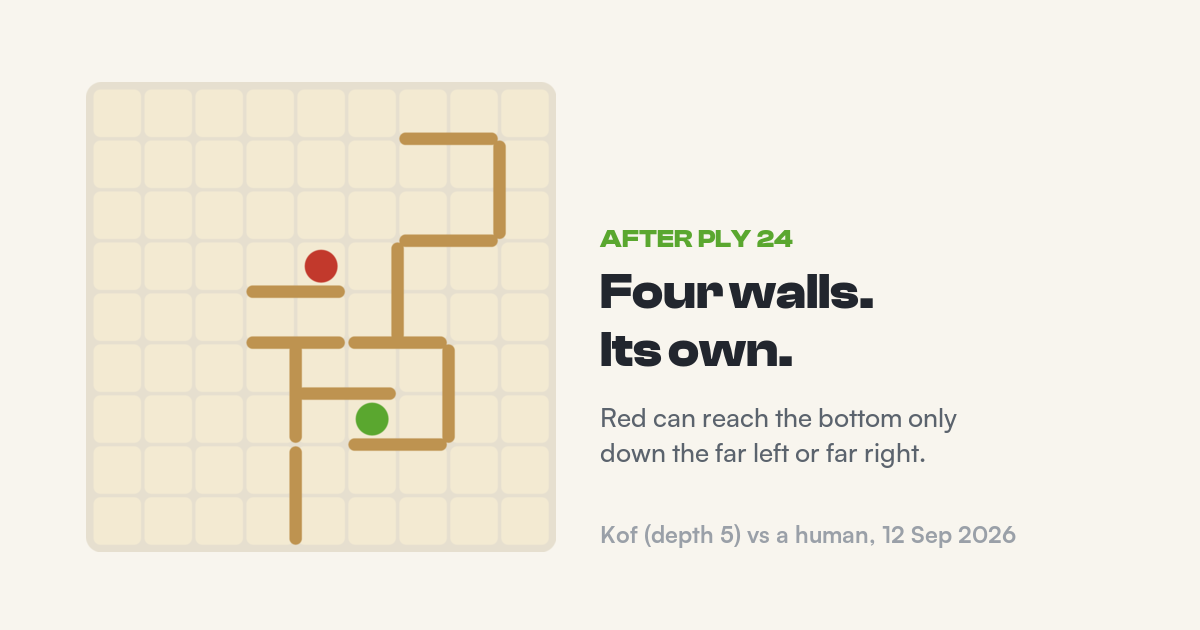
After ply 24. Four of the walls under the red pawn are its own. It can now reach the bottom edge only down the far left or the far right.
At plies 8, 10, 14 and 22 the bot placed four horizontal walls to slow the human. Each one, on its own, was priced as a gain on the shortest-path metric. Together they cut the bot's own board in half. After the fourth, the bot could reach its goal row only through the left three columns or the right two. A pair of human walls on the left costs it 8 extra squares, and a single wall on the right closes the other side. The bot did not choose badly between two openings. It spent the middle game deleting its own.
The wall that did it was the fourth one, at ply 22. Searches at depth 2, 3 and 4 all play it. Depth 5, 6 and 7 all reject it and advance the pawn instead. The phone was running Kof at a 1.5 second budget, which on that position is effectively depth 4. And a sweep from every ply confirms where the game was lost: a tempo-correct two-wall defender beats the bot from 44 of 93 continuations at ply 22 and from 0 of 84 at ply 24, and never again after that.
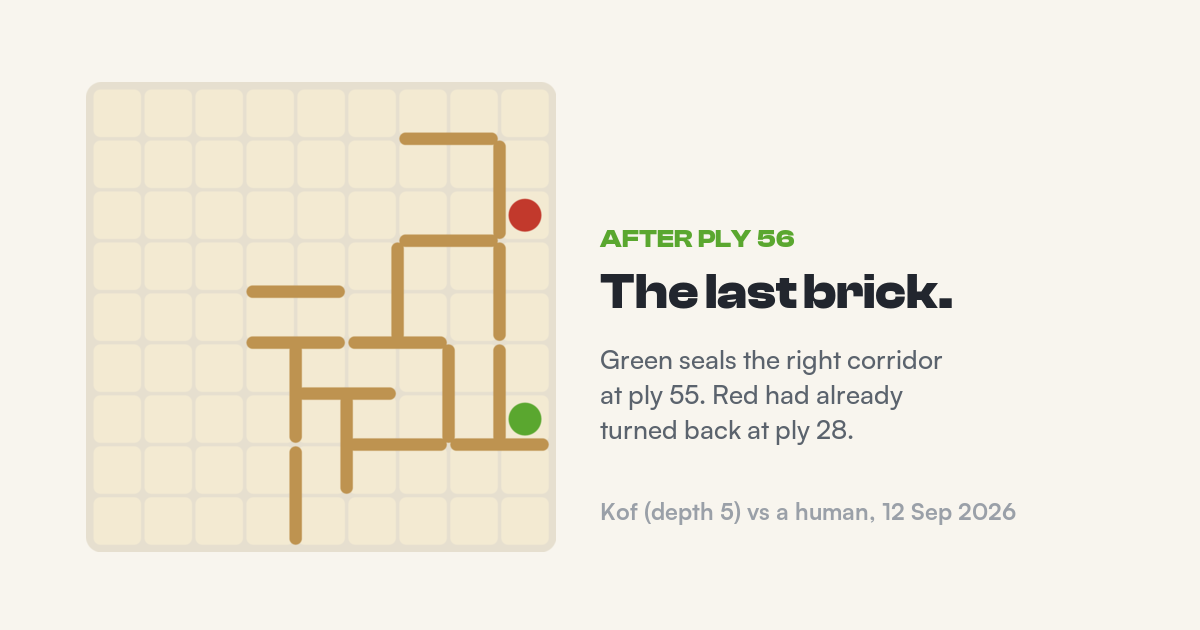
After ply 56. The human’s wall at the right edge (ply 55) is the last brick. The red pawn has already turned back.
One more thing from this game, because it is the kind of thing that looks like a bug and isn't. From ply 28 the bot retreats. It walks its pawn back up the board for seven moves. Our first read was horizon paralysis, and we went looking for the defect. But a depth 7 search plays the same retreat, and so does depth 11. In an isolated test with the same continuation on both sides, forcing the advance at ply 28 loses at ply 69 and the retreat wins at ply 72. The retreat was right. The game was already gone at ply 22, and everything after was the engine playing the least-bad line.
What we did instead
•
Stopped treating self-play and search value as evidence of anything. Every engine change now has to pass the 579-position bank and a comparison against the strong-human corpus, both of which are blind to the evaluation.
•
Shipped the wall-only sampling rule described above.
•
Left the depth where it was. The measurement says depth is not where the remaining strength is.
•
Started collecting fixtures: every notable loss by a top bot gets its full move list saved so it can be replayed at any depth.
The open problem is the leaf evaluation. Shortest-path difference is a good metric for an engine that walls in the right places, and a bad one for deciding where those places are. The human data says the answer involves walls that do nothing now and everything two moves later, and we do not yet have a cheap way to price that.
If you want the numbers behind the game itself rather than the engine, we published what 3.4 million recorded moves say about Quoridor, including a first-player win rate of 49.8% across 33,165 ranked human games. And if you want to try beating Kof, it is in the app.
Play the practice bots
F
Francis
CREATOR OF BLOCADE
Francis is the solo developer who designed and built Blocade — its bots, ranked ladder, and daily puzzles. These guides come straight from the person who made the game.
Follow Blocade on Google Search
Add playblocade.com to your Google Preferred Sources so Google shows the official game, guides, and daily puzzle solutions in AI Overviews and Search.
Add as Preferred Source
Ready to play?
Start a game against a bot right in your browser — free, no sign-up. Then take your streak with you on the app.