Get the app
← All articles
DATA · Jul 20, 2026 · 7 MIN READ
What 3.4 Million Quoridor Moves Say About How the Game Is Actually Played
First-player advantage, game length, wall usage and resignation rates, measured across 33,165 ranked Quoridor-style games and 3.4 million moves.
F
Francis
Creator of Blocade
★ Follow on Google
Almost everything written about Quoridor strategy is somebody's opinion. Play walls late, don't over-block, race when you're ahead — sound advice, but nobody has ever checked it against a large number of real games. We can. Blocade is a Quoridor-style game with a server-authoritative match log, so every move of every online game is recorded. This is what 3.4 million moves across 64,252 games look like when you add them up.
The headline numbers
Going first is worth nothing measurable: the opening player wins 49.8% of ranked games. The median game lasts 48 moves. Players use 7.1 of their 10 walls on average, and the players who win use more than the ones who lose — up to a point. Nearly half of all games end in a resignation, not a capture of the far row.
How we measured this
The numbers below come from Blocade's match database as of 20 July 2026. The full table holds 66,152 completed games. For anything about competitive play we use a stricter subset: ranked, human-versus-human, decided games — 33,165 of them. Games against bots are excluded everywhere, as are unranked and friend games, because bot behaviour and casual play would both distort the result. (The bots themselves are written up separately, in what we learned building the engine.)
•
Every game runs the same ruleset: a 9×9 board, 10 walls per player, no wall may leave an opponent with zero path. These are standard Quoridor rules, so the findings should transfer to the tabletop game and to other digital versions.
•
Seat 0 always moves first in ranked online games, which makes first-player advantage directly measurable rather than inferred.
•
Win rates are per player-game, so each game contributes one win and one loss.
•
Blocade players skew toward phone-length games and are self-selected, so treat these as figures for online play by a general player base, not for tournament experts.
Does the first player have an advantage?
In theory, yes. Quoridor is a finite two-player game with no draws, so one side has a theoretical win, and analysis of small boards points to the first player. In practice, across 32,337 ranked games where we have the opening move on record, that advantage does not show up at all.
| Games won | Win rate | |
|---|---|---|
| First player (moves first) | 16,118 | 49.8% |
| Second player | 16,219 | 50.2% |
The margin is 101 games out of 32,337. With a sample that size the 95% confidence interval runs from about 49.3% to 50.4%, which includes 50% — so this is a coin flip, and the small edge to the second player is noise rather than a finding. The honest conclusion is that whatever theoretical advantage the first player holds, human players don't convert it. If you have ever lost a game and blamed the draw, the data doesn't support you.
How long is a game of Quoridor?
The median ranked game lasts 48 plies — 24 moves each. The mean is 48.2, so the distribution is close to symmetric rather than dragged out by a long tail of marathon games. A pawn needs a minimum of 8 moves to cross a 9×9 board, which means a typical game spends roughly two thirds of its moves on something other than the shortest path: walls, detours, and the jockeying in between.
How many walls do players actually use?
Of all moves played in ranked games, 71.6% are pawn moves and 28.4% are wall placements. Across a whole game the average player spends 7.1 of their 10 walls, with a median of 8. Only 3.5% of players finish a game without placing a single wall, and 29.9% spend all ten.
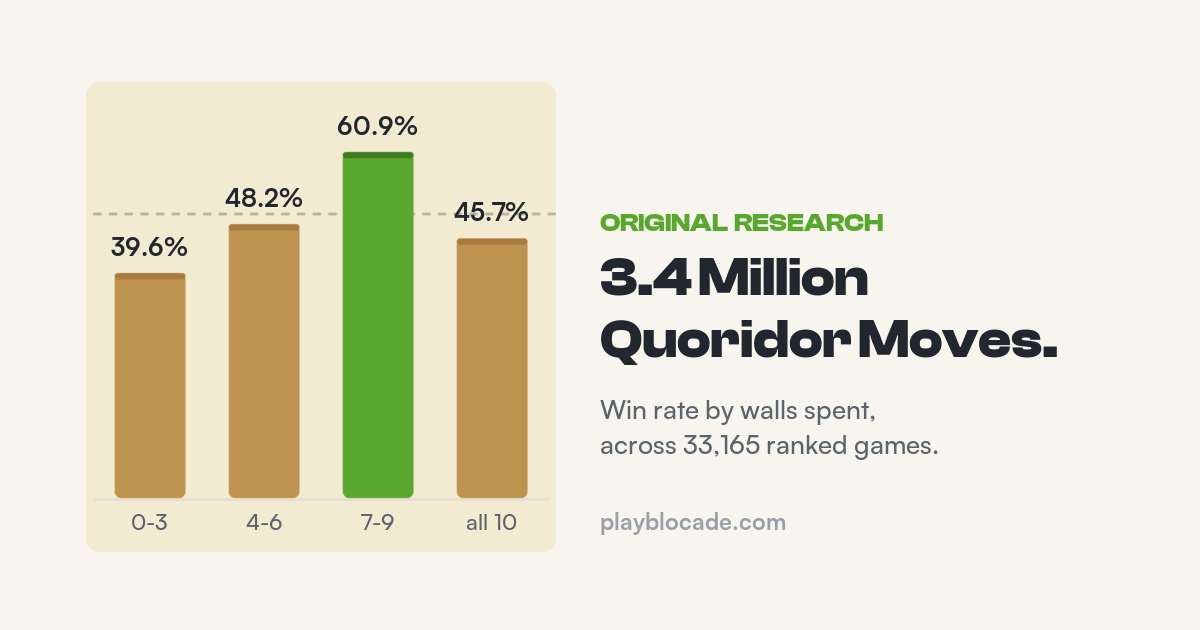
Splitting players by how many walls they used produces the most interesting pattern in the dataset.
| Walls used | Player-games | Win rate |
|---|---|---|
| 0–3 | 7,660 | 39.6% |
| 4–6 | 16,456 | 48.2% |
| 7–9 | 20,631 | 60.9% |
| All 10 | 19,102 | 45.7% |
Win rate climbs steeply with wall usage, peaks at 60.9% for players who spend seven to nine walls, then falls back to 45.7% for players who spend all ten. Hoarding walls is the worse mistake of the two — the 0–3 group wins under 40% — but emptying the whole supply is also associated with losing.
This is a correlation, and the direction is not obvious
Longer games allow more walls to be placed, and a player who is losing has more reason to keep spending them, so some of this effect runs backwards: losing causes wall spend rather than wall spend causing losses. The 0–3 group in particular is thick with short games that ended in an early resignation. Read the table as a description of what winning games look like, not as proof that placing your eighth wall will win you the game.
What do players do on the first move?
97.3% of ranked games open with a pawn move. Only 882 games out of 32,337 open with a wall, and those games are won by the opening player 46.3% of the time, against 49.9% for a pawn opening. The gap is small and the wall-opening sample is thin, but it points the same way as the conventional advice: a wall placed on move one is cheap to walk around, and the turn spent placing it is a turn not spent racing.
How do games end?
Only about half of ranked games are played to the finish. 46.4% end in a resignation and 4.1% end on the clock, leaving roughly half decided by a pawn actually reaching the far row. The resignation rate is high for a game this short, which fits a race you can see yourself losing several moves before it happens: once your opponent's remaining path is clearly shorter than yours and the walls to fix it are gone, the outcome is visible well before it arrives.
What this changes about how to play
1.
Stop worrying about who moves first. Across 32,337 games the advantage is not measurable.
2.
Spend your walls. The most common losing profile in the data is the player who finishes with most of their supply unused.
3.
Don't open with a wall. 97.3% of players already know this; the 2.7% who don't win slightly less often.
4.
Expect about 24 moves each. If your path is much longer than that with your walls gone, the game is probably already decided.
For the strategy behind these numbers — openings, wall geometry, and the endgame count — see the Quoridor strategy guide. For the rules themselves, start with Quoridor rules explained.
Quoridor statistics: frequently asked questions
Does the first player win more often in Quoridor?
Not measurably. Across 32,337 ranked online games, the first player won 49.8% — statistically indistinguishable from 50%. Quoridor is believed to be a theoretical first-player win, but human players do not convert that advantage.
How long does a game of Quoridor last?
The median online game lasts 48 plies, or 24 moves per player. The mean is 48.2, so very long games are rare.
How many walls does the average Quoridor player use?
An average of 7.1 walls out of 10, with a median of 8. About 30% of players use all ten, and 3.5% place none at all.
Is it better to use more walls or save them in Quoridor?
Players who spend 7–9 walls win 60.9% of their games, against 39.6% for players who spend 0–3. Some of that gap reflects losing players spending walls rather than wall spend causing wins, but under-using walls is strongly associated with losing.
What percentage of Quoridor games end in resignation?
46.4% of ranked online games end in a resignation and a further 4.1% end on time, so about half are played out to the far row.
Where does this Quoridor data come from?
From Blocade's match database: 3.4 million recorded moves across 64,252 games, of which 33,165 are ranked human-versus-human games. Figures are as of 20 July 2026.
Play a game and add to the data
Blocade is a free Quoridor-style game for browser, iOS and Android — the same 9×9 board, 10 walls, and no-full-block rule these numbers come from. Every ranked game played feeds the next version of this analysis.
Play free — no download
F
Francis
CREATOR OF BLOCADE
Francis is the solo developer who designed and built Blocade — its bots, ranked ladder, and daily puzzles. These guides come straight from the person who made the game.
Follow Blocade on Google Search
Add playblocade.com to your Google Preferred Sources so Google shows the official game, guides, and daily puzzle solutions in AI Overviews and Search.
Add as Preferred Source
Ready to play?
Start a game against a bot right in your browser — free, no sign-up. Then take your streak with you on the app.