Get the app
← All articles
STRATEGY · Jul 18, 2026 · 10 MIN READ
Quoridor Strategy: How to Win More Games
Quoridor strategy that wins: count shortest paths, time your first wall, build wall fences, use the jump, and know when to stop building and run.
F
Francis
Creator of Blocade
★ Follow on Google
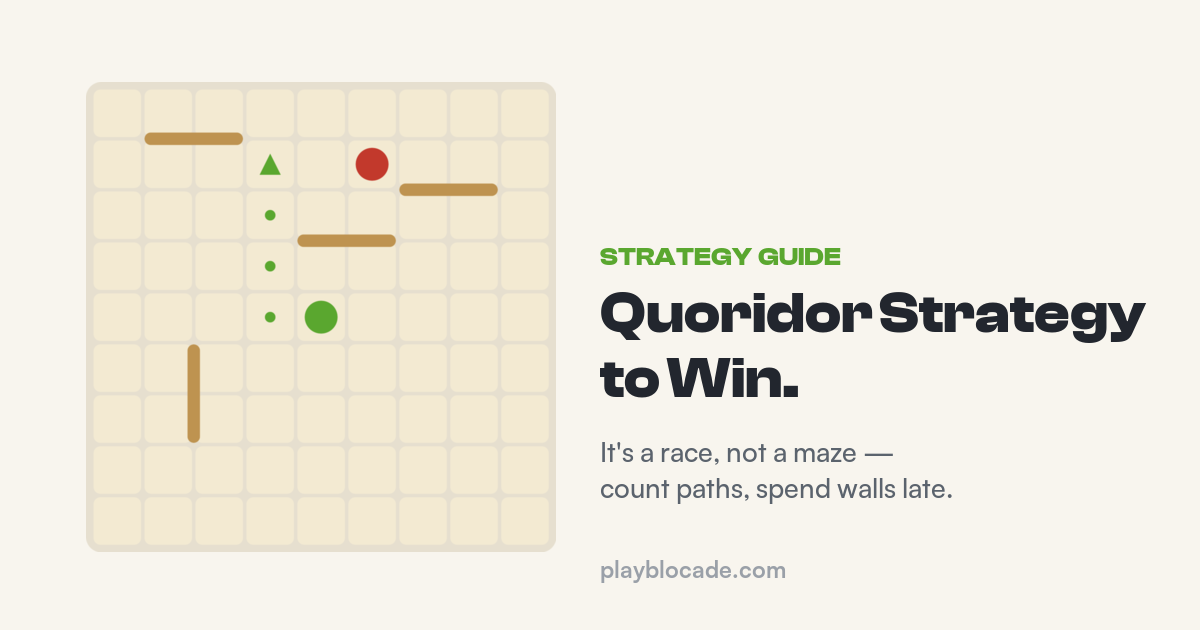
Quoridor looks like a game about building mazes. It isn't. It's a race, and every strong move comes down to one number: the length of your shortest path to the goal versus the length of theirs. This guide covers how to use that number — when to place your first wall, how to make walls work together, and when to stop building and run. If you need the rules first, read our Quoridor rules explainer and come back.
The one-number rule
Count the squares in your shortest path to the goal. Count your opponent's. If it's your turn and your number is lower, you're winning. Every turn should either lower your number or raise theirs — a turn that does neither is a wasted move.
It's a race, not a maze
The no-full-block rule means a wall can never trap anyone. Walls only tax a route; they can't close it. So the game is decided by who arrives first, and everything else is arithmetic about arrival times.
I learned this the direct way: I built the bot engine for Blocade, which plays the same race-and-wall ruleset. The evaluation that beat every clever heuristic I tried was the plain one — run a pathfinder for both pawns and compare the two path lengths. The engine looks a few moves ahead, but the number it's optimizing is the same one you can count on your fingers mid-game. Players who track it beat players who don't, at every level I've watched.
The advice below is also checkable now. We measured 3.4 million moves across 33,165 ranked games: 97.3% of players open with a pawn move rather than a wall, players who spend seven to nine of their ten walls win 60.9% of the time, and going first turns out to be worth nothing measurable.
Opening: walk first, wall later
The standard opening is to move your pawn straight up the middle for the first three or four turns. The center is the strongest lane because it keeps both flanks open — whichever side your opponent walls, you have a detour of equal length waiting on the other side.
Early walls are almost always wasted. In the opening, your opponent's route is still flexible, so a wall placed on move two gets side-stepped for a single square of tax — you paid one of your ten walls and a full turn for it. And if your opponent walls early? Don't retaliate. Keep walking. Each early wall they spend is a turn you gained in the race and one fewer wall they'll have when it matters.
If you want the named lines rather than the general principle, our Quoridor openings guide walks through each one and checks it against 33,165 real games — including which openings actually hold up and which are folklore.
When to place your first wall
Place a wall when it buys real distance, not when you feel nervous. Concretely, that means waiting for one of these:
•
Their number is about to beat yours. If their path is one square shorter and it's their move, you need a wall now — that's the position walls exist for.
•
They've committed to a lane. Past mid-board, a pawn has picked its route. Walls placed near a committed pawn cost several squares; walls placed on an uncommitted one cost one.
•
There's a choke. Where existing walls or the board edge already narrow their options, one more wall forces a long detour instead of a side-step.
A good habit before every wall: trace their new shortest path after the placement, out loud if you have to. If the wall adds fewer than two squares, hold it.
Wall economy: you have ten, spend them like money
Each player gets ten walls and they never come back, so every placement has an exchange rate: squares added to their path, minus squares added to yours. A wall that adds four squares to their route and none to yours is excellent. A wall that adds two to theirs and two to yours did nothing — walls block both players, and building a maze you have to walk through yourself is the classic self-inflicted loss.
Walls you're still holding count too. A player with six walls in hand is a standing threat to any route near a choke, and your opponent has to plan around that threat even before you spend it. This is why burning walls early hurts twice — you lose the distance they could have bought later, and you lose the pressure of holding them.
Walls work in teams
A lone wall in open space is weak — the pawn steps around its end for a one- or two-square tax. Walls get strong when they're anchored: placed end-to-end against the board edge, or against walls already on the board (including your opponent's). Each extension of an anchored fence pushes the walk-around point further away, so the detour grows with every wall while your cost stays one wall per turn.
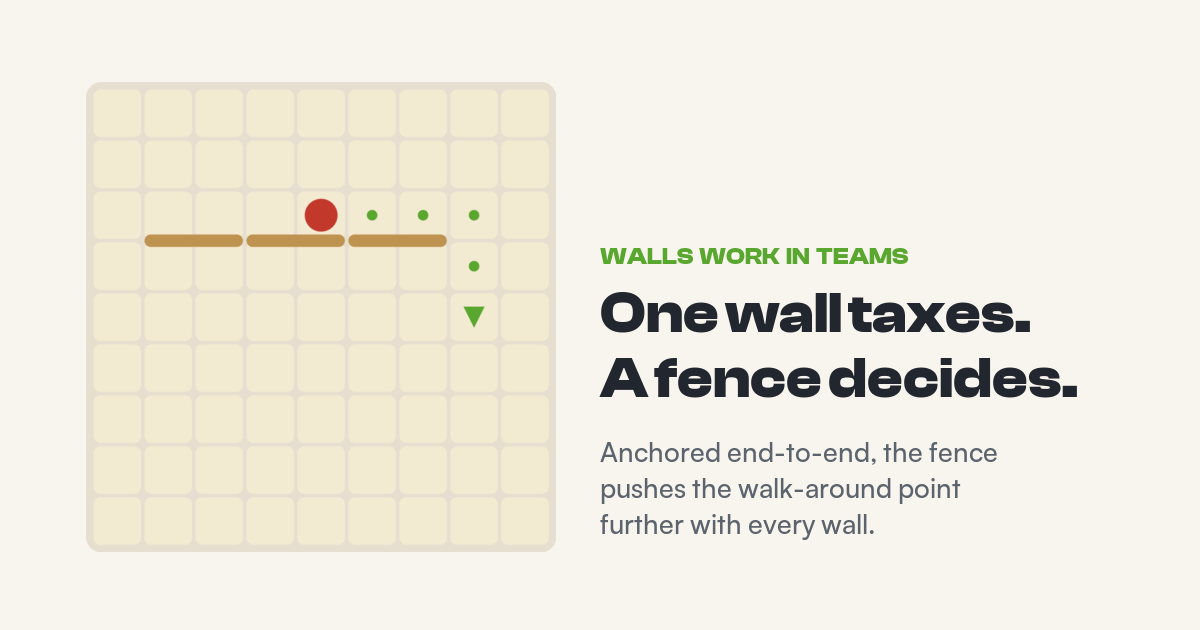
One wall is a side-step. A fence built end-to-end forces the walk all the way around.
The habit to build: before placing any wall, look at what's already on the board and ask whether your wall can touch it. Extending an existing structure — yours or theirs — almost always buys more distance than starting a new wall in the open.
Defend your lane before you attack
Every wall you place is a turn your opponent can use against you, so check the reply before you commit: if I spend this wall, what does their best wall do to my route? The common losing pattern in mid-level games is spending your last walls on offense while your own corridor still has one open slot — which your opponent then closes, and the detour flips the race. Keep your route at least two squares wide where their walls could reach it, or keep a spare route on the other flank.
The jump is a free turn
When the pawns meet face to face, the player to move jumps clean over — two squares of progress in one turn. In a tight midgame that single tempo often decides the race, so pay attention to parity as the pawns close in: if stepping forward puts you adjacent on *their* turn, they get the jump, and you just gave away a move. Sometimes the right play is a wall or a side-step purely to flip who arrives at the meeting square second.
Endgame: know when to stop building and run
There's a point in most games where the walls stop mattering: your number is lower, and their remaining walls can't raise it enough to matter. Find it by tracing your route and asking where a wall could still hurt it — a route hugging the board edge or running alongside existing walls often has no legal slots left to attack. Once your path is wall-proof and shorter, every remaining turn should be a step. Spend leftover walls only on their runner, as close to their pawn as possible, where the detour is biggest.
Mistakes that lose games
1.
Walling in the opening. The tax is one square; the cost is a wall and a turn.
2.
Answering every wall with a wall. Racing punishes a wall-happy opponent harder than revenge does.
3.
Ignoring your own side of the exchange. If a wall adds as much to your path as to theirs, it wasn't a move.
4.
Forgetting the jump — in both directions. Gift a tempo and the endgame math flips.
5.
Hoarding all ten walls. Walls unspent when they cross the finish line were worth nothing. When the count says spend, spend.
6.
Watching the pawn instead of the path. A pawn that looks close may be nine squares out. React to the number, never to proximity.
Spend or hold? A quick reference
| Situation | Action | Why |
|---|---|---|
| Opening (moves 1–4) | Hold, walk the center | Early walls are side-stepped for one square |
| Their path drops below yours | Spend | This is the moment walls exist for |
| Their pawn is committed at a choke | Spend, anchored | One wall costs them several squares |
| Your route is shorter and wall-proof | Hold and run | Steps win; walls no longer change the race |
| Their pawn is 2–3 squares from home | Spend everything useful | Any added square might flip the finish |
| You're nervous but the count favors you | Hold | React to the number, never the feeling |
Is Quoridor solved?
No — the standard 9×9 game is not solved. Nobody knows whether the first or second player wins with perfect play. Deciding who wins from an arbitrary Quoridor position has been proven PSPACE-complete, the same complexity class as Go and Hex, so a full solution is out of reach for current computers. Strong engines exist — Blocade's bot searches over the shortest-path difference described above — but 'strong' is not 'perfect'; we wrote up what searching deeper did and didn't fix in our own engine.
Smaller boards *have* been solved. On a 5×5 board the second player wins when each side has four walls or fewer, and the first player wins with more — so the answer depends on wall count as much as board size, and no one has shown which way the 9×9, 10-wall game tips. In practice it doesn't matter much: across 33,000 ranked human games on Blocade, the first player won 49.8% — a coin flip. Whatever the theoretical answer is, the edge is far too small for humans to feel.
How to practice
Strategy reading only sticks when a loss makes it concrete. The fastest loop I know is the one we built into Blocade: play a match against the bot ladder, then open Game Review — it grades every move by how much win-chance it gained or lost, which is the path-difference math from this guide, run by the engine. A wasted wall shows up as a graded mistake with the better move next to it. Blocade uses the same race-and-wall ruleset as Quoridor (here's how the versions compare), so everything transfers directly to the physical board.
From the official @blocadeapp on TikTok ↗
Quoridor strategy: frequently asked questions
What is the best first move in Quoridor?
Move your pawn forward, straight up the middle. The center lane keeps both flanks open, so any early wall can be answered with an equal-length detour on the other side. Placing a wall on the first few turns is almost always a wasted move.
When should you place your first wall in Quoridor?
When it buys real distance — usually once the pawns are near mid-board and your opponent's route is committed, or the moment their shortest path is about to become shorter than yours. A wall that adds fewer than two squares to their path should stay in your hand.
Is Quoridor a game of luck or skill?
Pure skill. Quoridor has no dice, no cards, and no hidden information — both players see the whole board at all times. The stronger path-counter wins, which is also why it rewards study the way chess does.
How do you beat someone who places walls early?
Keep walking. Early walls are side-stepped for about one square of tax, so each one your opponent places costs them a turn in the race and a wall they no longer have for the endgame. Racing is the punishment; retaliating with your own early walls just evens the mistake.
Has Quoridor been solved by computers?
No. The full 9×9 game has not been solved, and deciding the winner of a position is PSPACE-complete. Small boards are solved (5×5 flips between a second- and first-player win depending on wall count), but perfect play on the real board is unknown — and in 33,000 ranked human games the first player won 49.8%, a coin flip.
What is the single most important Quoridor strategy?
Count both shortest paths every turn — yours and your opponent's. Every strong move either lowers your number or raises theirs. Players who track this one number consistently beat players who react to how close the enemy pawn looks.
Where can you practice Quoridor strategy online for free?
Blocade uses the same race-and-wall rules and is free in the browser or on iOS and Android, with a bot ladder to climb and a post-game review that grades each move — see the how to play Blocade guide to get started.
Put it on a board
Pick one habit from this guide — the one-number count is the right first pick — and play ten games with it. Blocade is the fastest way to get those reps: free, in your browser, against bots that will absolutely punish a wasted wall.
Play free — no download
F
Francis
CREATOR OF BLOCADE
Francis is the solo developer who designed and built Blocade — its bots, ranked ladder, and daily puzzles. These guides come straight from the person who made the game.
Follow Blocade on Google Search
Add playblocade.com to your Google Preferred Sources so Google shows the official game, guides, and daily puzzle solutions in AI Overviews and Search.
Add as Preferred Source
Ready to play?
Start a game against a bot right in your browser — free, no sign-up. Then take your streak with you on the app.