Get the app
← All articles
STRATEGY · Jul 20, 2026 · 8 MIN READ
Quoridor Openings: The Named Lines, and What 33,165 Games Actually Show
The Shiller, Reed, Stonewall and other named Quoridor openings — what each one is, and what 33,165 ranked games actually show about opening play.
F
Francis
Creator of Blocade
★ Follow on Google
Quoridor has a set of named openings — the Shiller, the Reed, the Stonewall, the Sidewall, the Gap. They get repeated across strategy sites as though they were chess openings with a century of analysis behind them. They aren't. This page explains what each one is, is straight about how thinly documented they are, and then does the thing nobody has done with them: checks opening play against 33,165 ranked games.
The short version
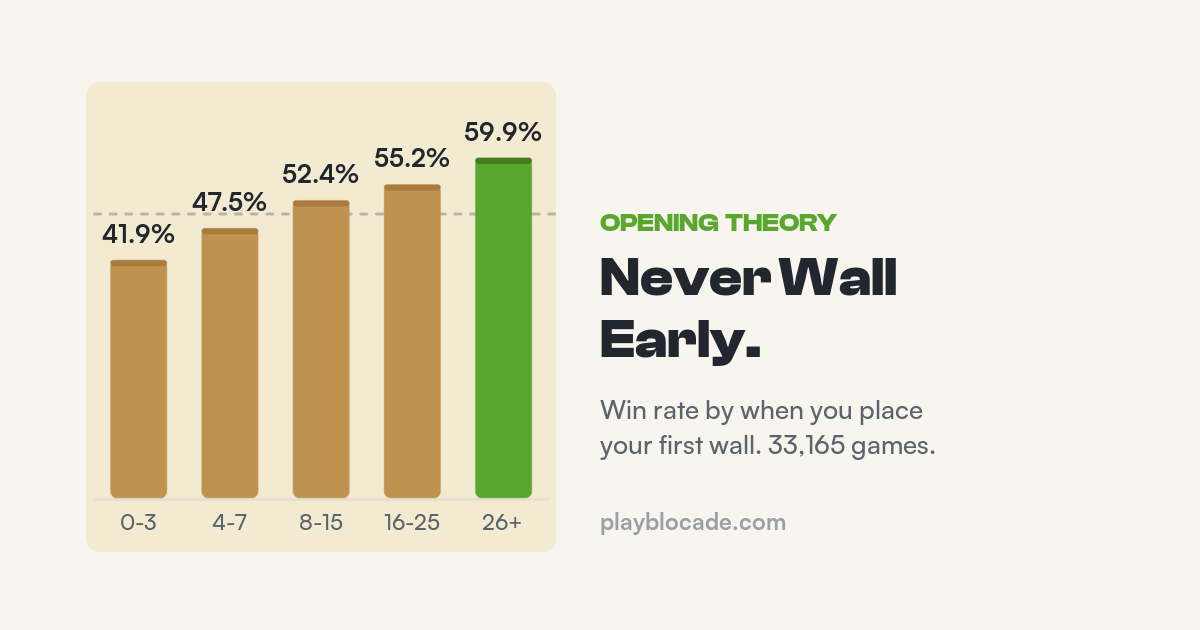
The named openings are community folklore, not a documented literature — Wikipedia's list of them carries no citations at all. What is measurable is much simpler: 77.6% of games open with the exact same four moves, and the single biggest opening mistake is placing a wall too early. Players who place their first wall in the first four plies win 41.9% of the time. Players who hold off past ply 26 win 59.9%.
A warning about Quoridor opening theory
Before the names: Quoridor has no equivalent of chess's opening books. There are no tournament databases, no published analysis, no annotated master games in general circulation. The named openings mostly come from a single Wikipedia section, and that section cites no sources for any of them — the Reed opening has carried a "citation needed" tag since June 2023. Several openings are attributed to named individuals whose connection to the game we could not independently verify.
None of that makes the openings useless. Named or not, they describe real, sensible ideas, and players do play them. But treat them as community shorthand rather than established theory, and be sceptical of any site that presents them with more confidence than that. This one is going to show its working instead.
The named openings
These are the lines you will see referenced. Descriptions reflect how the community uses the terms.
| Name | The idea | How well documented |
|---|---|---|
| Standard opening | Both players simply advance the pawn straight up the middle. The default. | Coined on BoardGameGeek in December 2010, for the pawn moves only |
| Shiller opening | Advance the pawn three times, then place a wall behind your own pawn on move four — keeping your route short while leaving the opponent more than one way through. | One primary source, which does not name it or specify the wall's orientation |
| Reed opening | Two horizontal walls placed early on the opponent's side of the board. | No verifiable source for the attribution; flagged "citation needed" since 2023 |
| The Stonewall | A horizontal barrier built across the board to force a long detour. | Uncited |
| The Sidewall | Walls worked along the edge to squeeze the opponent's route toward one side. | Uncited |
| Gap opening / Anti-gap | Leave a deliberate gap in a wall line, then close it later; the anti-gap answers it. | Uncited |
| Ala, Shatranj, Lee Inversion, Rush, Quick Box | Named variations that appear on the Wikipedia list. | Names only — little or no substance behind them |
Different Quoridor communities use completely different names
Here is the clearest sign that this is folklore rather than theory. The Wikipedia list is not what strong players actually use, and the separate Quoridor communities do not share a vocabulary at all.
•
The most-watched Quoridor openings video on YouTube teaches five openings under names like the Standard Copy and the Black Rush. None of them appear on the Wikipedia list.
•
The largest online Quoridor teaching group, on Board Game Arena, developed roughly fifteen terms of its own for move quality and uses none of the Wikipedia names.
•
The Japanese Quoridor community maintains its own canon, including named openings that exist nowhere else in any language.
Three serious communities, three vocabularies, almost no overlap. Compare that with chess, where the Sicilian is the Sicilian in every country and every club. Quoridor opening names tell you which corner of the internet someone learned the game in, and not much else.
What players actually play
Across 32,337 ranked games where the opening is on record, opening play is far more uniform than the list of names suggests. 94.3% of first moves are a pawn straight ahead. 3.0% step sideways. Only 2.7% open with a wall.
Extend that to the first four plies and the convergence is stark: 77.6% of all ranked games begin with the identical sequence — both pawns marching straight at each other, twice each. Whatever the named openings describe, the overwhelming majority of real games start the same way.
| First move | Share of games | Win rate for the player making it |
|---|---|---|
| Pawn straight ahead | 94.3% | 49.9% |
| Pawn sideways | 3.0% | 50.8% |
| Wall | 2.7% | 46.3% |
The sideways opening looks slightly better than marching forward, but with only 972 games behind it the margin is well inside the noise — treat it as "no measurable difference." The wall opening is a different story. Its 46.3% sits far enough below 50% to be a real effect rather than sampling noise.
The one opening mistake the data is certain about
Sorting every player by when they placed their first wall produces the cleanest pattern in the whole dataset. It runs in one direction, without exception.
| First wall placed | Player-games | Win rate |
|---|---|---|
| Ply 0–3 (very early) | 4,230 | 41.9% |
| Ply 4–7 | 22,899 | 47.5% |
| Ply 8–15 | 29,655 | 52.4% |
| Ply 16–25 | 4,343 | 55.2% |
| Ply 26 or later | 499 | 59.9% |
Every step later you place your first wall, your win rate goes up — an 18-point spread from earliest to latest. And the effect shows up independently from both sides of the board. When the second player places a wall on ply 3, the first player goes on to win 60.8% of those games. When the first player places a wall on ply 2 instead, their win rate drops to 44.5%. Whoever commits a wall first in the opening comes off worse, whichever seat they are in.
What this does and doesn't prove
These are correlations. Some of the effect certainly runs backwards: a player who is already losing the race has more reason to start throwing walls up early, so early walls partly *mark* a losing position rather than cause one. What the symmetry does rule out is a simple seat or skill artefact — the penalty lands on whichever player walls first, regardless of which side they're on.
How to open, in practice
1.
Walk forward. The standard opening is standard because it works, and 94.3% of players have converged on it.
2.
Don't reach for a wall in the first few moves. It is the one opening decision the data punishes clearly, from either seat.
3.
Wait until a wall costs your opponent real distance. Early in the game there is too much open board — they simply walk around it, and you have spent a turn to achieve nothing.
4.
Don't worry about which named opening you're playing. There is no opening book to fall behind on. Path length is the thing that decides games.
From the official @blocadeapp on TikTok ↗
For the mid-game and endgame ideas these openings feed into, see the Quoridor strategy guide. For the full dataset behind these numbers, including game length, wall usage and resignation rates, see what 3.4 million moves say. New to the game? Start with the rules.
Quoridor openings: frequently asked questions
What is the Shiller opening in Quoridor?
Advance your pawn three times, then place a wall behind your own pawn on move four, keeping your own route short while leaving your opponent more than one way through. The single primary source for it is a personal page by Larry Shiller, which describes the idea but does not name it after him and does not specify the wall's orientation — the more precise versions circulating online add detail that source doesn't contain.
What is the Reed opening?
Two horizontal walls placed early on the opponent's half of the board. Like the other named openings it is uncited — Wikipedia has flagged it "citation needed" since June 2023.
Is there a Quoridor opening book?
No. Quoridor has no published opening theory, no tournament database and no annotated master games in general circulation. The named openings are community shorthand rather than an established literature.
What is the best opening move in Quoridor?
Advancing your pawn. 94.3% of ranked players do it, and the alternative of opening with a wall wins measurably less often — 46.3% against 49.9%.
Should you place walls early in Quoridor?
The data says no. Players who place their first wall within the first four plies win 41.9% of their games; players who wait past ply 26 win 59.9%. The same penalty applies to whichever player commits a wall first, from either seat.
Are Quoridor opening names standard?
No. Separate Quoridor communities use entirely different vocabularies — the most-watched openings video, the largest Board Game Arena teaching group and the Japanese Quoridor community each use their own names, with almost no overlap between them or with the Wikipedia list.
What is the most common Quoridor opening?
Both pawns advancing straight toward each other. 77.6% of ranked games open with that identical four-ply sequence.
Try it yourself
Blocade uses the same 9×9 board, ten walls and no-full-block rule these games were played under. It is free in a browser, on iOS and on Android, and its post-game review grades every move — including how much that early wall actually cost you.
Play free — no download
F
Francis
CREATOR OF BLOCADE
Francis is the solo developer who designed and built Blocade — its bots, ranked ladder, and daily puzzles. These guides come straight from the person who made the game.
Follow Blocade on Google Search
Add playblocade.com to your Google Preferred Sources so Google shows the official game, guides, and daily puzzle solutions in AI Overviews and Search.
Add as Preferred Source
Ready to play?
Start a game against a bot right in your browser — free, no sign-up. Then take your streak with you on the app.